When an installation or a maintenance shutdown means sending a crew to another province, costs appear that aren't part of the day-to-day: mileage, hotels, meals, tolls. You have to pay them correctly to the employee, treat them correctly in payroll and, on top of that, charge them to the job that generated them. Otherwise, that installation will look more profitable than it really is. This article reviews what the IRPF (Spanish personal income tax) rules say about per diems and travel expenses, and how to organise them in practice.
What the IRPF Regulation says
The amounts you pay an employee for travelling away from their usual workplace may be exempt from IRPF (Spanish personal income tax), within certain limits. This is governed by article 9 of the Reglamento del Impuesto sobre la Renta de las Personas Físicas (Personal Income Tax Regulation), approved by Real Decreto 439/2007 (Royal Decree 439/2007). The main points, according to the current text:
- These are trips to a municipality other than the employee's usual place of work and their place of residence.
- The company must be able to prove the day and place of the trip and its reason or purpose.
- If travel to the same municipality exceeds nine continuous months, the exemption for subsistence and accommodation expenses generally stops applying.
The exempt amounts
These are the amounts set out in article 9 of the Regulation, with the per-kilometre rate updated by Orden HFP/792/2023 (Ministerial Order HFP/792/2023):
| Item | Spain | Abroad |
|---|---|---|
| Travel in own vehicle | €0.26 per kilometre, plus justified tolls and parking | Same as in Spain |
| Travel by public transport | The amount of the expense justified by an invoice or equivalent document | Same as in Spain |
| Subsistence, with overnight stay | €53.34 per day | €91.35 per day |
| Subsistence, without overnight stay | €26.67 per day | €48.08 per day |
| Accommodation | The amounts that are justified | The amounts that are justified |
Anything you pay above these amounts is taxed as employment income. And what is exempt is one thing, what you must pay is another: the amount of per diems due to the employee is set by your collective agreement or the contract. It may be higher or lower than the tax limits.
Social Security contributions have their own rules on these items. Before setting up payroll, check with your employment advisers.
Before applying the figures
The Regulation includes particular cases (for example, for drivers of road goods transport vehicles) that are not covered here. The amounts can change by ministerial order, so check the consolidated text on the BOE (Spain's official gazette) before each tax year.
How to organise the travel for an installation job
An installation away from home lasts days or weeks and moves several people. To stay in control:
- Budget for travel in the quote. Kilometres, hotel nights, per diems per person and day. It's one more line item, and often the one that overruns the most.
- Decide who drives and who pays. If one company van carries four people, there is only one vehicle; if everyone goes in their own car, that's four sets of mileage.
- Appoint someone responsible for the trip to keep the hotel, toll and parking receipts.
- Record every day who travelled, where to, whether they stayed overnight and how many kilometres. This lets you prove the trip and calculate the per diem due.
- Keep an eye on the nine months if the installation is long or you string together jobs in the same town.
What to record each day of the trip
To justify per diems and calculate the cost properly, the same information should be noted down every day, without depending on anyone's memory. A minimum list:
| Data | What it's for |
|---|---|
| Employee and date | Knowing who each per diem is due to |
| Place (municipality) and job | Proving the trip and charging it to the job |
| Purpose | Proving the reason for the trip |
| Whether they stay overnight or not | Applying the per diem with or without an overnight stay |
| Kilometres and vehicle | Paying mileage only to whoever uses their own vehicle |
| Tolls, parking and accommodation | Keeping the receipts for the expenses |
If this record comes from the same daily report, the employee doesn't have to fill in another piece of paper and the office doesn't have to reconstruct the trip at month end.
Charging expenses to the right job
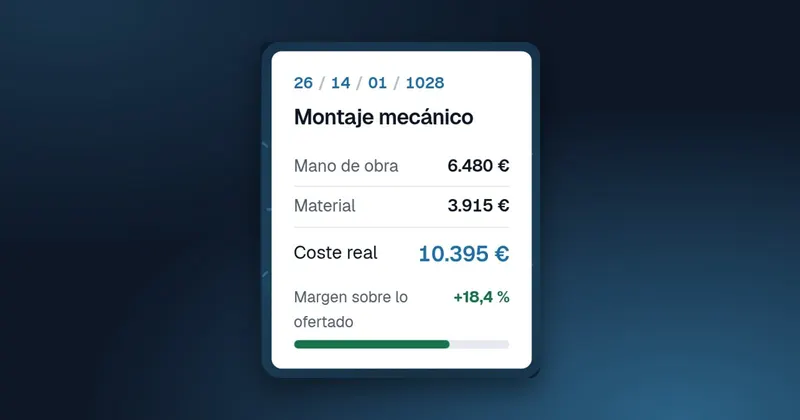
Travel is a cost of the job, just like hours and materials. If you log it under overheads, an installation in another province will look as profitable as one next door, and it isn't.
For example, with made-up figures: a crew of four spends ten days in another province, staying overnight. For subsistence alone, with a per diem equal to the exempt limit, that would be 4 × 10 × €53.34 = €2,133.60, to which you must add hotel, mileage and tolls. It's an amount that has to appear in the cost of the job and, if possible, in the quote.
Common mistakes
- Paying flat-rate per diems without recording the day, place and purpose.
- Paying mileage to someone who travelled in the company van.
- Forgetting that travel hours are also hours, and deciding under the collective agreement how they are counted.
- Leaving travel out of the quote and then finding it in payroll.
Travel and per diems in GControl
In the GControl app, employees record their travel, per diems and kilometres alongside their working day and work report, both for the job and for the employee themselves, with the person responsible if there is one. They can do it at the company or at the client's work site, and the office sees it in real time. The hours on the work reports are allocated to each job and valued using the price list by job category.
You can find it on the work reports page and, to see how everything comes together in the result of the job, on cost per job.