You do a stock count and you're missing twenty metres of pipe, three boxes of fixings and a handful of fittings. They haven't been stolen: they've gone in offcuts, damaged parts, and material someone took for a job without noting it down. That difference is shrinkage, and it is a real cost. If you leave it in the warehouse as a general loss, your jobs look cheaper than they really are. If you charge all of it to the last job that passed through, that job comes out badly for no reason. This article explains how to deal with it.
Where shrinkage comes from
It's worth telling the causes apart, because they aren't all solved in the same way:
- Offcuts and leftovers: material that is sold or bought in lengths or boxes that don't match what is actually used. It is unavoidable and part of real consumption.
- Breakages and defects: parts damaged in transport, during installation or in the warehouse.
- Unrecorded issues: material taken to a job without being noted down. This isn't real shrinkage, it's consumption that was never allocated.
- Goods-in errors: delivery notes loaded incorrectly or wrong quantities.
The last two can be cut back a lot with good discipline. The first two have to be measured and allocated.
First, the stock adjustment
Before allocating anything, your stock has to reflect what is actually on the shelves. The usual process is this:
- Do a physical count of items, at least of those that move most or are worth the most.
- Compare it with the theoretical stock (goods in minus recorded issues).
- Check the large differences before accepting them: often it's a delivery note that hasn't been loaded or an issue booked to the wrong item.
- What is left after that check is the shrinkage for the period. Adjust the stock so that it matches the count.
Counting over short periods and by material family gives better results than one big annual stocktake, because the differences are smaller and it is easier to remember what happened.
How to allocate the cost across jobs
The shrinkage of a material has been generated by the jobs that used it. The sensible approach is to share it among them. There are several possible criteria:
| Criterion | How it works | When it fits |
|---|---|---|
| Proportional to consumption | Each job receives shrinkage according to the quantity of that material it consumed | It is the fairest when issues are properly recorded |
| Proportional to hours | According to the hours charged to each job in the period | General consumables that are not recorded per job |
| Equal shares | The same amount to each active job | Small amounts, when it isn't worth being precise |
What matters is that the allocation is made only among the active jobs that use that material. Charging pipe shrinkage to an electrical maintenance job that hasn't touched a pipe distorts both.
An example
With made-up figures: the steel pipe stock adjustment for a quarter gives shrinkage of €1,000. In that period, four active jobs have consumed pipe: the first 50% of the total, the second 25%, the third 15% and the fourth 10%. Using the consumption criterion, they receive €500, €250, €150 and €100. Each one bears the share of the loss that corresponds to it, and no unallocated loss is left in the warehouse.
When shrinkage is a warning sign
Small, stable shrinkage is normal. It's worth investigating when:
- A particular material has far higher shrinkage than in previous periods.
- The shrinkage is concentrated in one job or one team.
- Differences appear in expensive items that are not easily cut or broken.
- Theoretical stock is regularly higher than actual stock: this usually points to issues that aren't being noted down.
In those cases allocation is not the solution: you need to review how warehouse issues are recorded.
How to reduce the shrinkage that isn't unavoidable
- Make sure every issue from the warehouse carries the code of the job it is going to, even if it's just a box of fixings.
- Make sure leftovers coming back from a job are returned to stock with a goods-in entry, instead of staying in the van.
- Make sure usable offcuts have a place in the warehouse and are checked before cutting new material.
- Make sure purchase delivery notes are loaded on the same day the material arrives, with the quantities checked.
These measures don't eliminate shrinkage, but they make the figure you allocate small and reliable, and mean each job bears what it has really consumed.
Common mistakes
- Leaving shrinkage in overheads. Jobs look more profitable and the next quote comes out too tight.
- Allocating without adjusting. If the stock isn't up to date, you are allocating a figure that isn't real.
- Charging it to a single job, usually whichever is open when someone notices.
- Not including shrinkage in the quote. If you know part of every bar is lost, price it in from the start.
Shrinkage in GControl
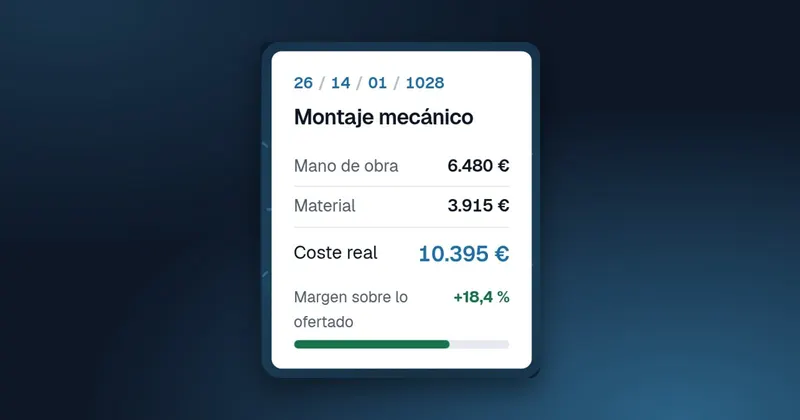
In GControl, material reaches a job in three ways: a direct purchase from an external supplier assigned to the job, an issue from your warehouse (deducted from stock and charged to the job) and allocation. The last one is the one for shrinkage: a stock adjustment is shared among the active jobs that use that material. Purchases not assigned to any job generate stock in the cost headings and items you define, and you always have the stock valuation report at hand.
That way the cost of each job includes the real material, including what comes out of the warehouse. You can see it on the material and stock page, and how it all adds up in cost per job. If you still have questions, check the frequently asked questions.